
What’s at Threat?
Every day work and life are ripe with opportunities for us to feel defensive: misreading an email, getting cut off on the road, a manager saying, “I’d like to give you some feedback” or not saying anything at all. It’s enough to drive us nuts with assumptions, stories and most of all, fear.
By definition, we feel defensive when we sense we have something to protect. And we get self-protective when that something feels under threat. We think we’re in danger, even though we’re not being chased by a bear or anything at all.
When I ask clients what’s at threat when they’re feeling defensive, 9 times out of 10 they say, “Nothing.”
But if we dig a little deeper, we get to it. It’s not about being chased by a bear. It’s about things more fundamental to our nature that we’d go to battle (literally and figuratively) to defend.
I’m not a neuroscientist but I know this little bit about the brain: it’s wired to detect threat and there’s really no way to shortcircuit the wiring. This is actually a good thing because it’s helped us survive for a very long time. The challenge though, is that our brains interpret threat liberally and often we perceive it where there is none.
This triggers defensiveness that often takes the form of fight or flight: for example, being argumentative, hostile, and snarky or avoiding, minimizing and distancing ourselves. Fight and flight are very human reactions to stress but neither are very effective, especially the higher up you move in an organization.
It’s hard to lead, make good decisions, collaborate, and communicate when we’re all armored up*, not because we’re in actual danger, but out of fear that something essential to our nature is at risk.
Regardless of what we’re doing out in the world—leading, working, learning, playing—we get triggered when we feel a threat to our identity: how we see ourselves and what we believe makes us successful, in work and in life.
Leadership Strengths v. Identities
Some very smart people have written about and developed tools around 3 core strength areas that are gifts when we’re at our best, most creative selves. They are our ability to build relationships, solve problems and get results—skills of the heart, head & will.
But when stuff gets hard and we’re operating from a reactive, defensive state, we fall into patterns of behavior constructed to protect these strengths. This is when they tip from gift to liability.
Here’s what this looks like:
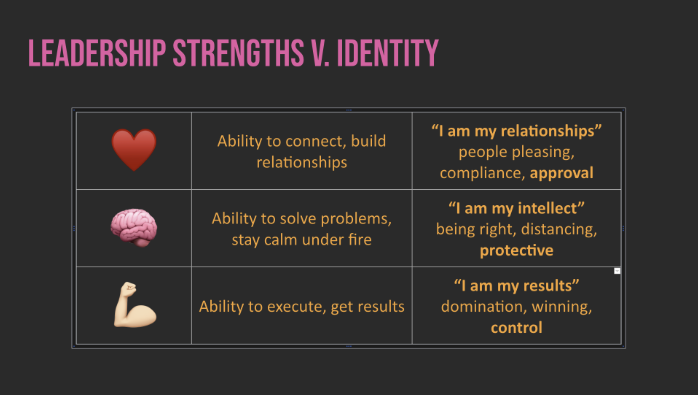
A perceived threat to any of these rocks our sense of security, stokes fear and often has us double down on the identity in a bit of a vicious cycle.
But here’s the good news: when clients explore this pattern, they can begin to break it. The exploration is a forever practice, like exercise. So as a soft start, consider doing these things:
Notice when you’re in a reactive state, operating below the line
Reflect on what identity might feel under threat
Try to suss out the stories you’re telling yourself that feed your fear like…
I can’t handle the discomfort of not being liked
If I’m wrong people will think I’m incompetent
If this isn’t done my way we won’t succeed
Pick up a copy of *Brene Brown’s Dare To Lead; it’s oh so very good
And know that, in spite of the fear and the stories, you’re safe.